Celebration! “Return of Ultraman” 50th Anniversary
A compilation of the project to make soft vinyl monster dolls walk on batteries Vol.4
No.15 Compatible monster “Leogon"
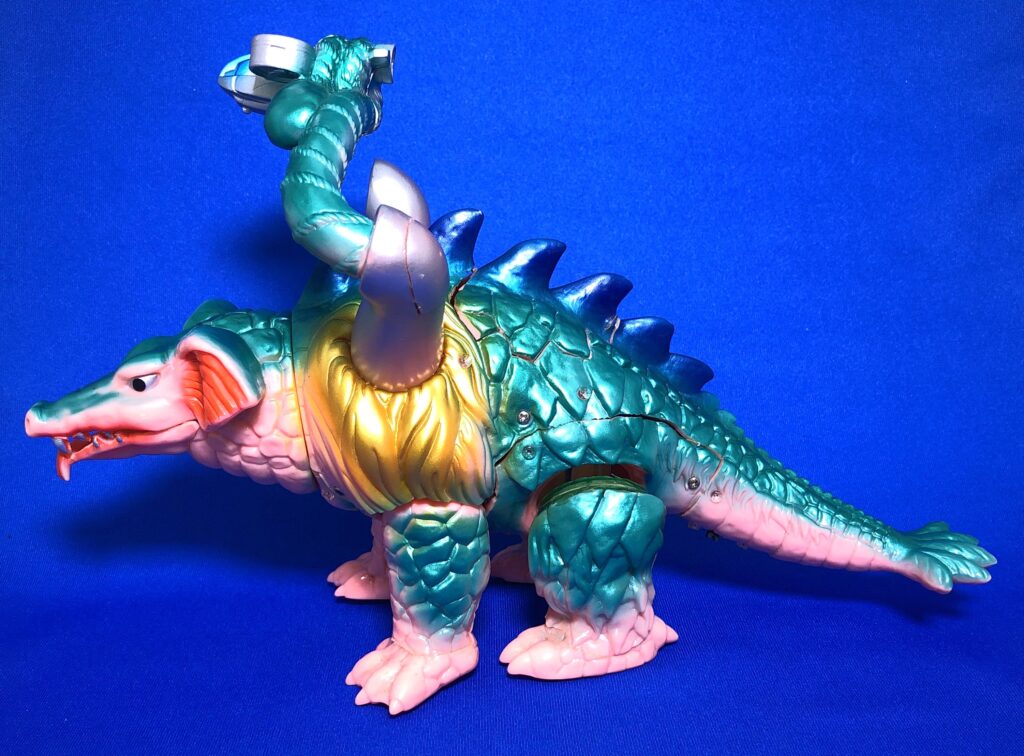
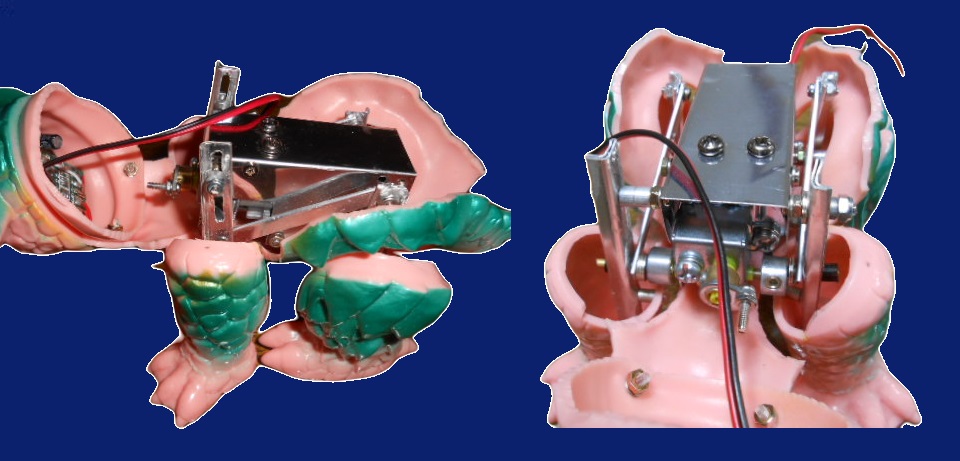
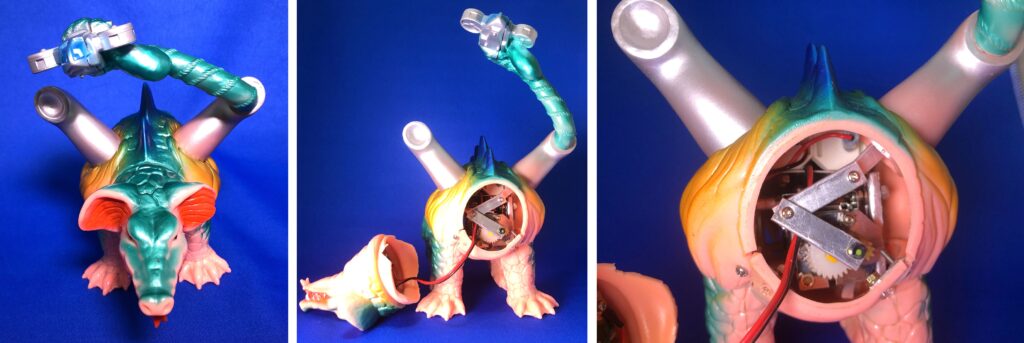
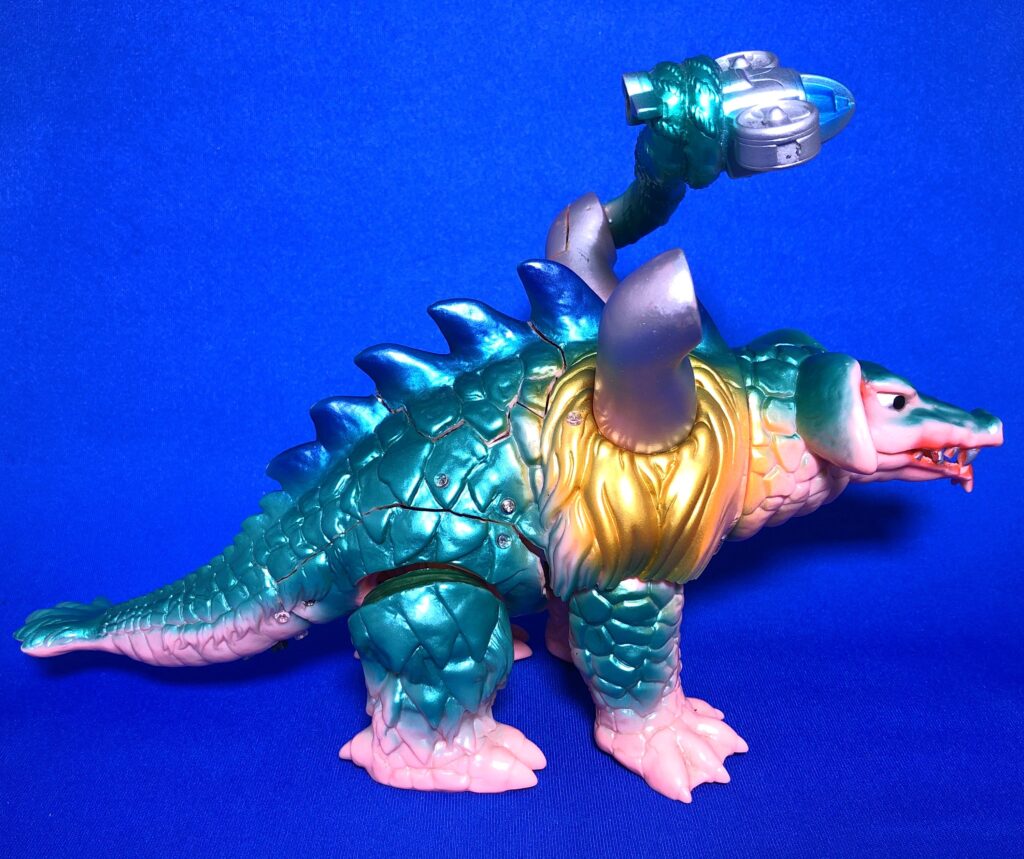
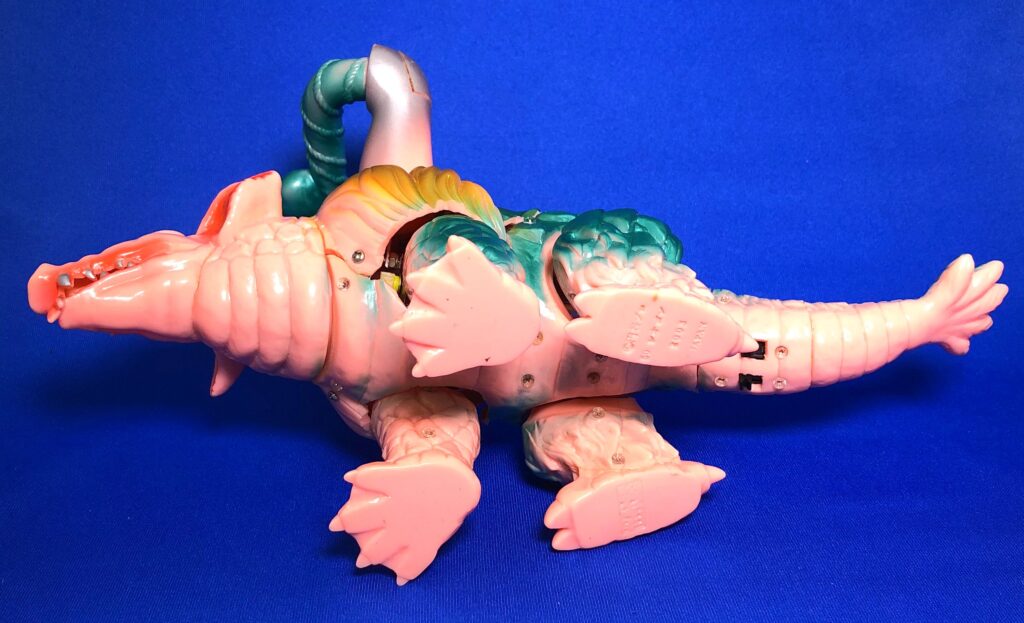
This is the project’s first full-fledged quadrupedal monster. The “Kingsaurus III" that I introduced earlier also moves its four legs, but I mentioned that the front legs do not contribute to forward motion. The walking system of this “Leogon" is the “Imai (insect series) type" in the classification defined in the 7th article. In terms of plastic models, the insect series by Imai and Bandai, and Nitto's “Jiger" and “Wanigon" are representative. The drive unit of this “Leogon" was made referring to the Imai “Walking mainspring."
By the way, this quadrupedal walking mechanism is more complicated than I expected. The following is an excerpt from “The Mechanism of Walking Toys" in the “Encyclopedia Nipponica." As the “front leg" of Imai “Walking mainspring" and “Leogon" moves up and down with a crank contrary to the commentary, please read the latter half with the “front leg" and “back leg" interchangeable.
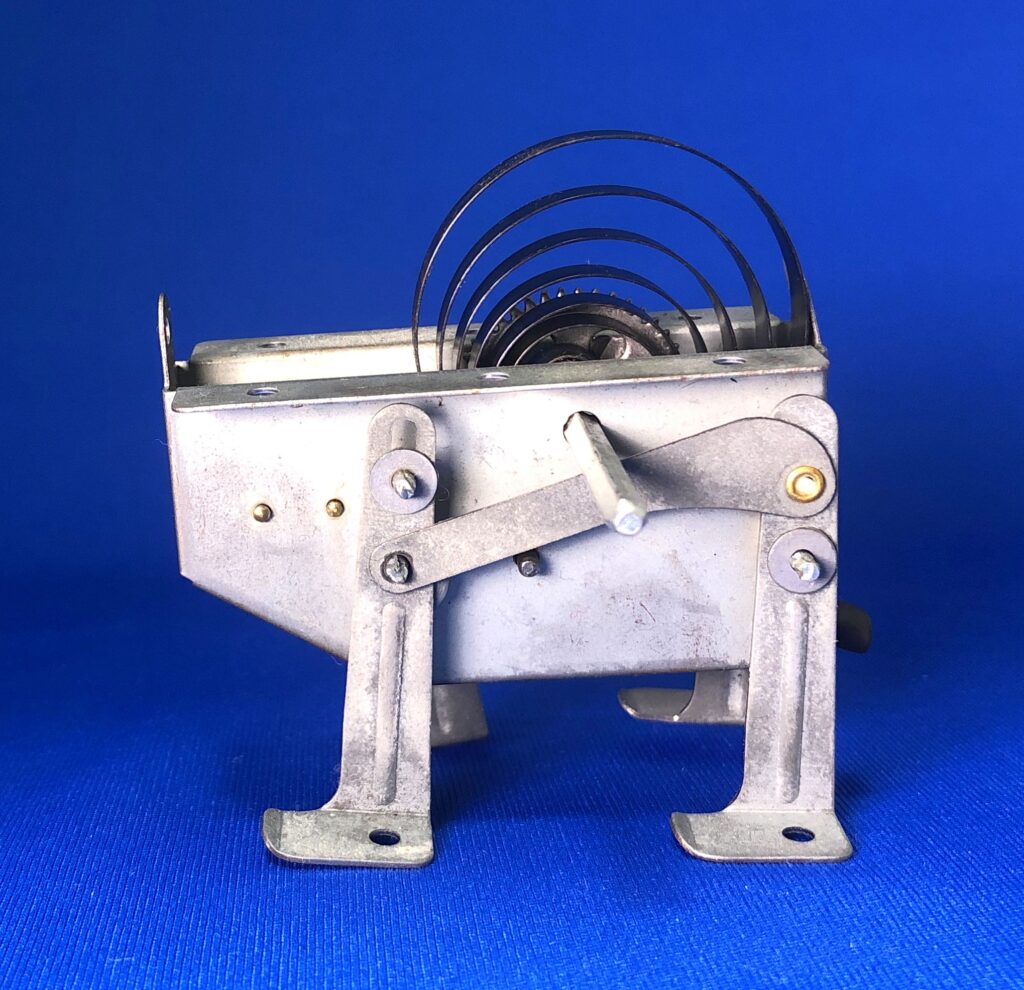
The left one is the front leg, and it moves up and down.
Walking toys, however, are simple and cleverly made. In a four-legged walking toy, the four legs are designed to move in opposite directions at the same time. In other words, the right front leg and left back leg move forward, then the left front leg and right back leg move forward. It consists of left and right front and back legs each in one piece, with the center of movement back and forth on the centerline of the underside of the torso, connected by bars so that the front and back legs move in opposite directions. The back leg can move slightly up and down as well as back and forth, so it is always supported by three points: two points on the front legs and one point on the back leg, so the body will not fall. The front legs just slide across the floor, but one point on the back leg also works to move forward.
※From the commentary on “The Mechanism of Walking Toys" by Encyclopedia Nipponica
https://kotobank.jp/word/%E6%AD%A9%E3%81%8F%E7%8E%A9%E5%85%B7%E3%81%AE%E4%BB%95%E7%B5%84%E3%81%BF-1614435
According to this, in the end, the front legs (the back legs in “Leogon") are just sliding on the floor, which are the same as walking only on back legs (the front legs in “Leogon"). However, by moving the front legs (the back legs in “Leogon"), the entire center of gravity is kept within the triangle composed of the three legs landing on the floor, thereby preventing falls. I am not an expert in this field, so my interpretation may be wrong, but the point is that making a quadruped walk is not as easy as it looks.
For this project, I used the soft vinyl doll “Leogon (MAT Gyro captured version)" from Kaijūkyō as the material, so I decided to also move the MAT Gyro captured by the ivy. The movement of the Gyro is performed by attaching a crank arm to the 2mm output shaft of the “Universal Gearbox" and converting its rotational motion into vertical movement.
No.16 Urvogel monster “Terochilus"
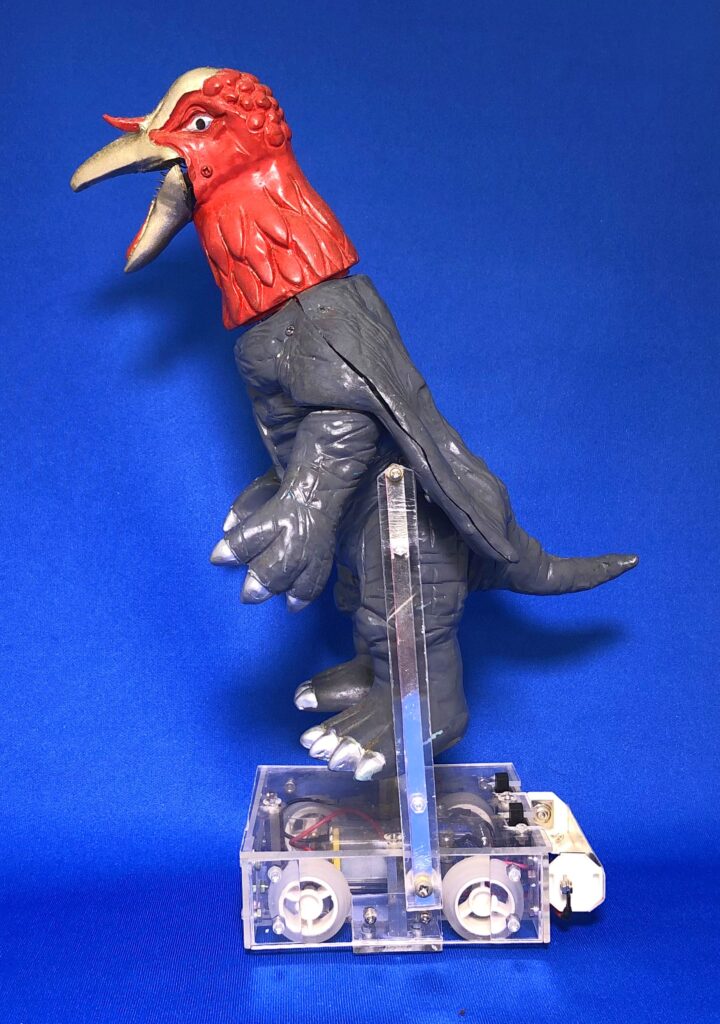

An image picked up from the Internet
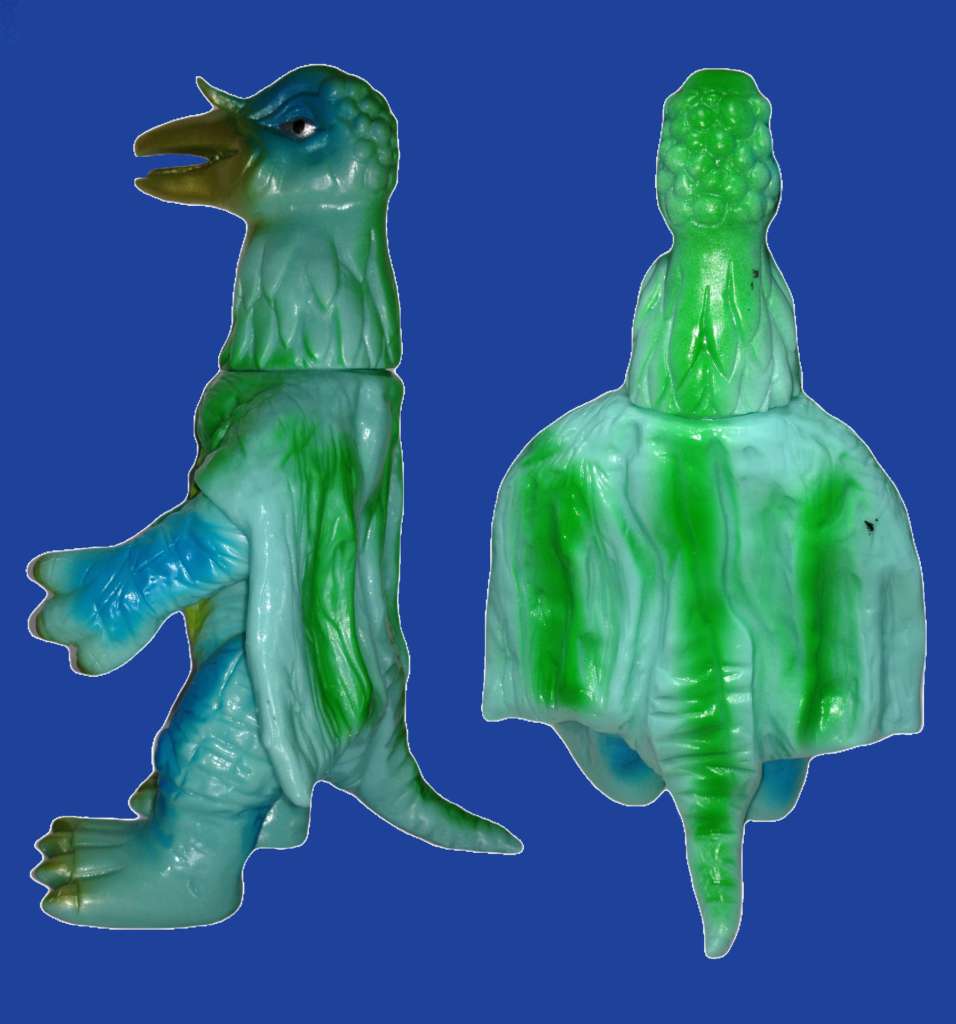
This time, it is “Terochilus" using a Bullmark soft vinyl doll. The original looks like Masao Komatsu's “Shirake-dori (means unamused bird)," but if you color it properly, it will look like a monster.
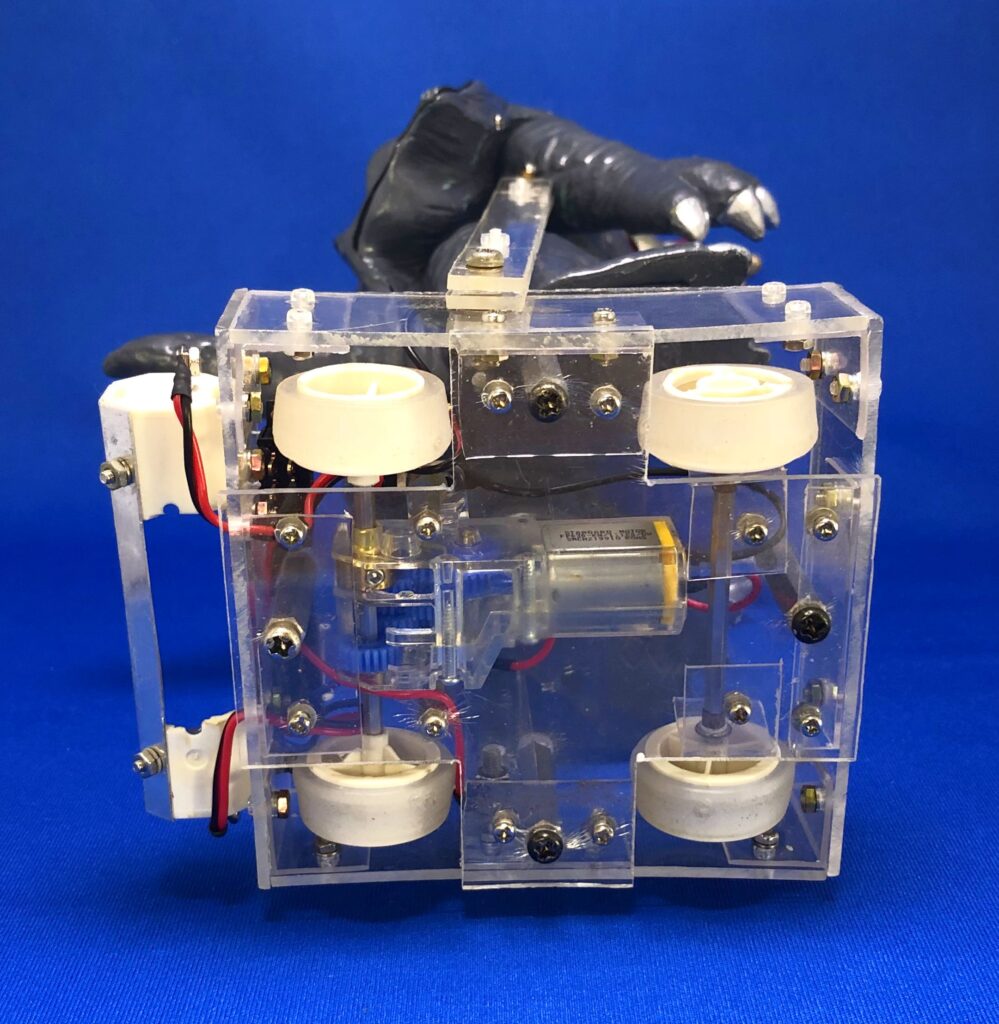
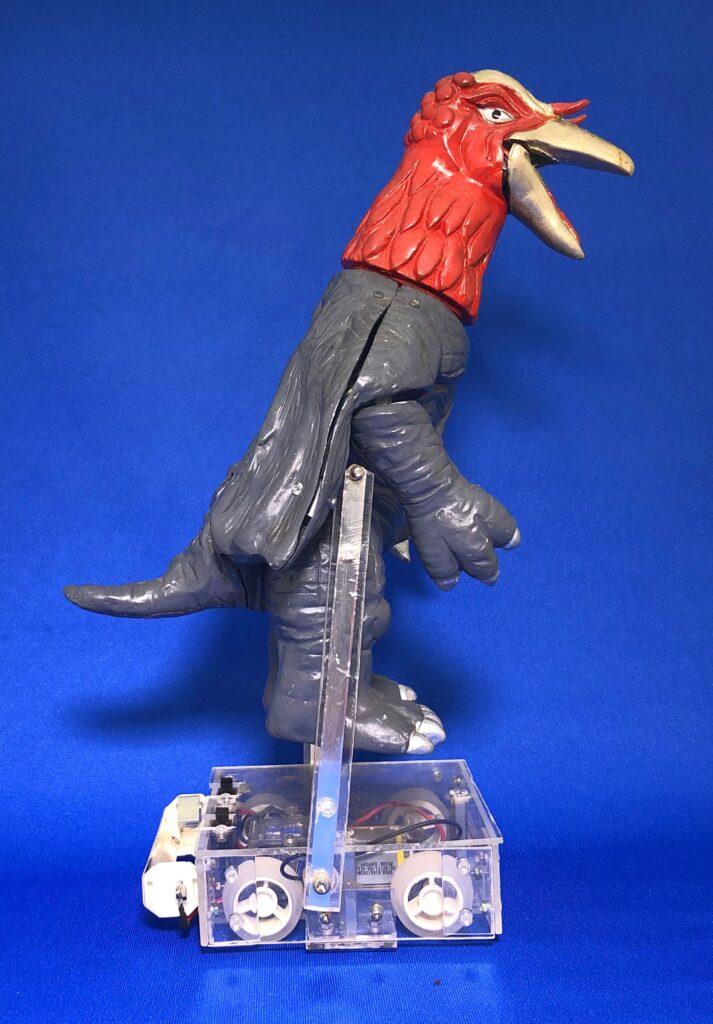
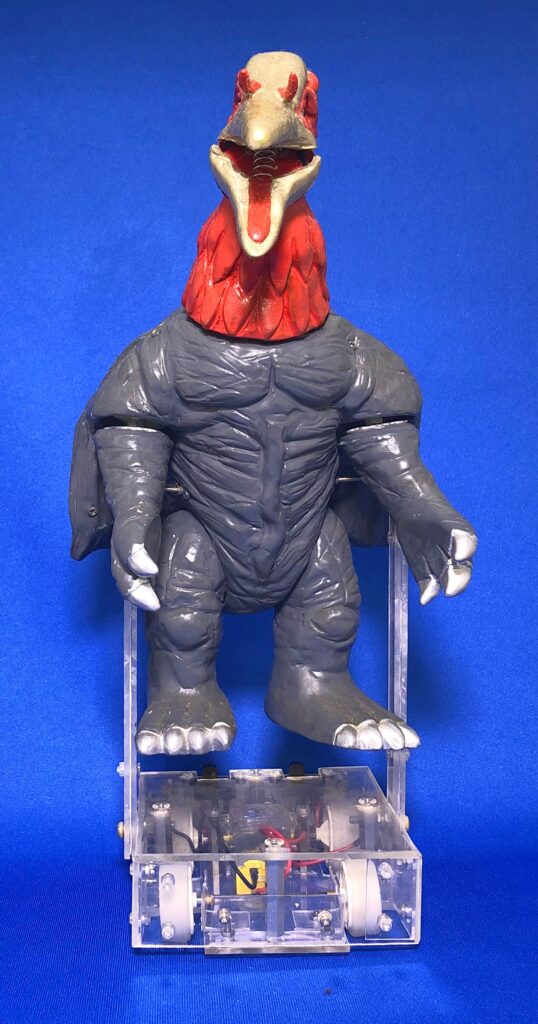
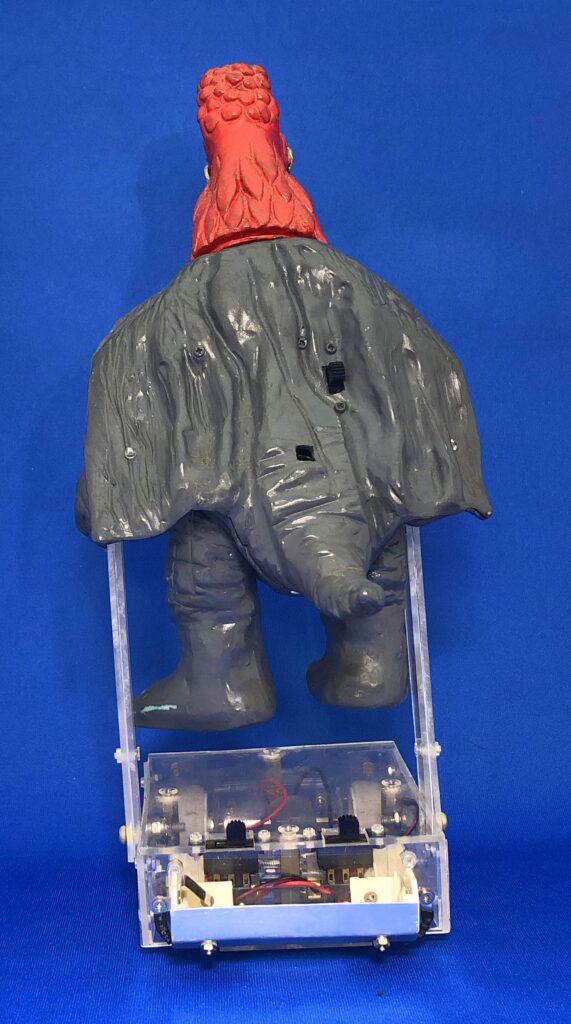
Terochilus is a flying monster, but I couldn’t actually make it fly, so I used high-speed movement on a cart to express the image of flight. Moving around on the ground was not interesting enough, so I also made it to swing both arms, open and close its beak, and shake its head from side to side.
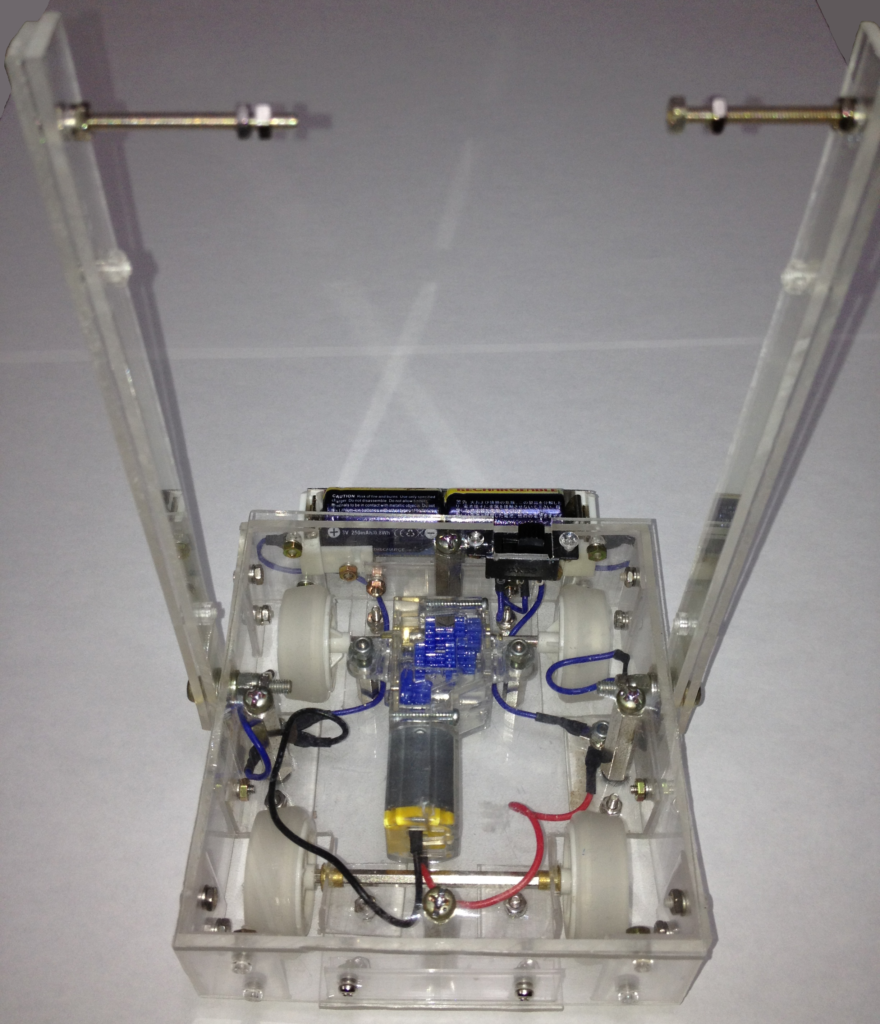
The dolly runs on tires with Tamiya's “Mini-motor Standard Gearbox" in the transparent box. The power comes from the external battery box, but is also supplied to the vertical long two bars. In order to move the arms and neck, the body of ”Terochilus” has a built-in “Universal Gearbox" which is powered by the bars. And the main body of ”Terochilus” can be removed from these bars.
The arm, beak, and neck movements all depend on the rotational motion of the crank arm attached to the 3mm output shaft of the “Universal Gearbox." Because the rotation axis of the arm is not parallel to the output shaft, a hard connector cannot be used to connect to the crank pin. So a soft rubber connector is used. The vertical movement of the crank pin opens and closes the beak, and the horizontal movement moves the neck left and right. Regardless of whether the movement on the dolly was good or bad, I think I was able to express the movement of ”Terochilus” itself as if it was a living creature.
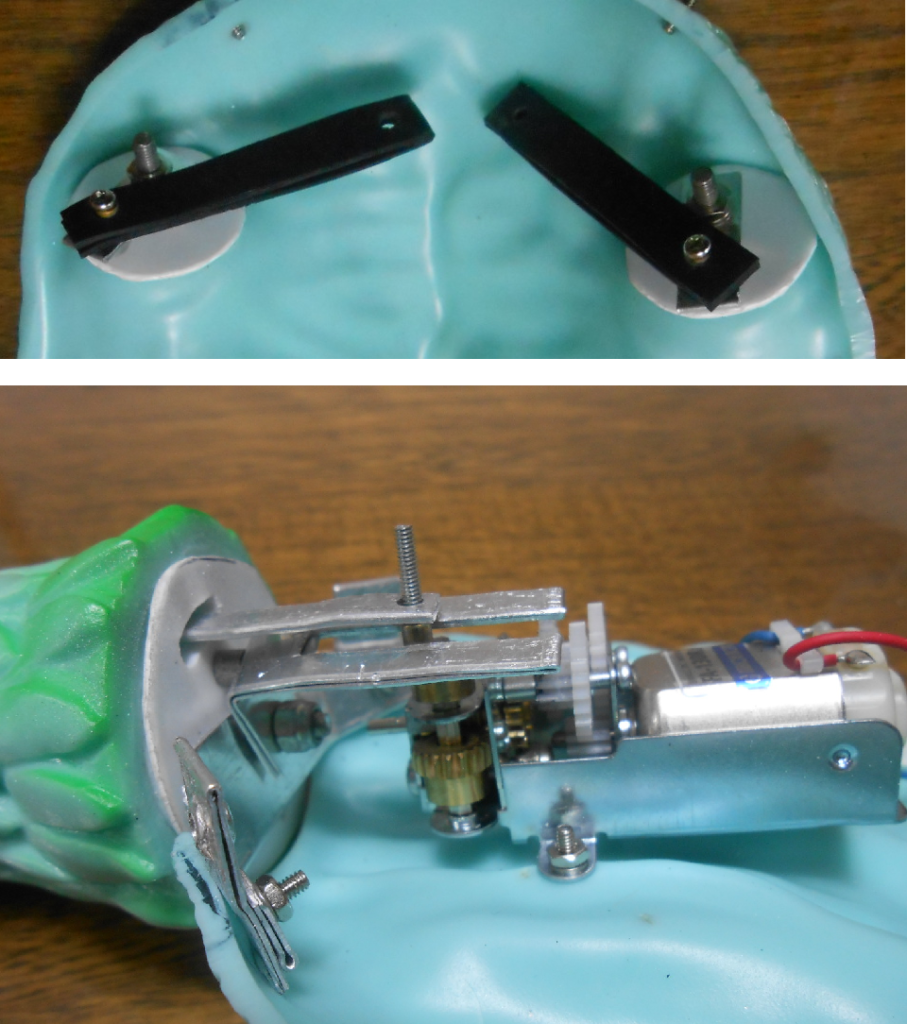
Lower right: The upper bar is for opening and closing the beak, and the lower bar is for swinging the neck
No.17 Space phantom “Sasahiler"
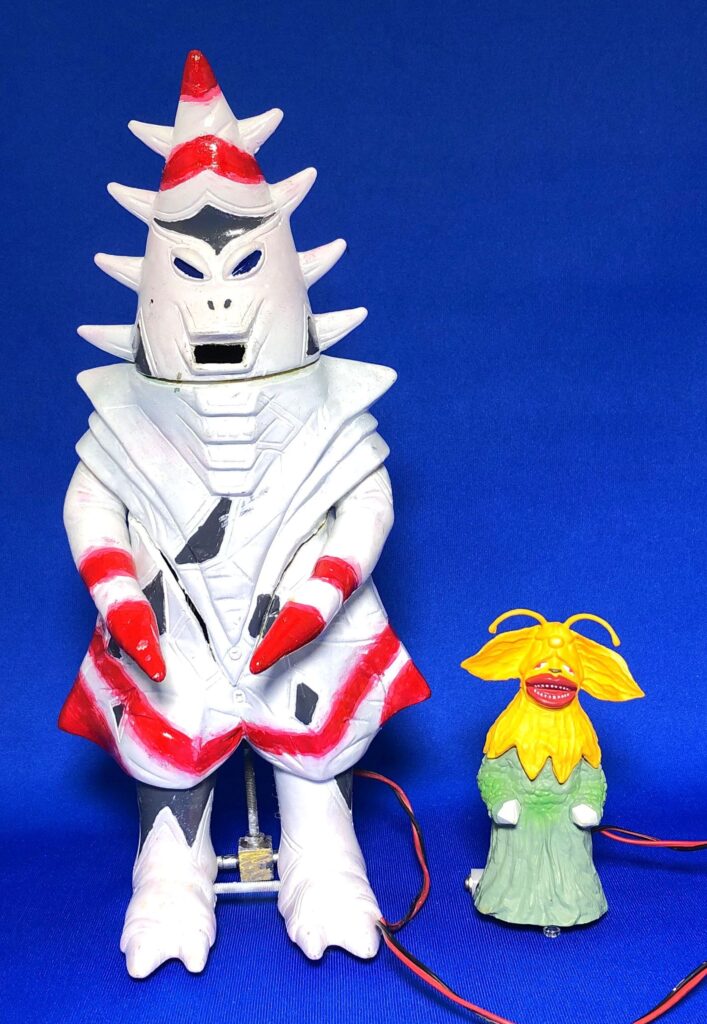
There are only three more monsters left to be introduced in this project. This time, I’ll be taking a look at the “Sasahiler," which appears in episode 48, “I’m Taking the Earth." I love this episode, especially at the end, when Gō got hiccups in the car and worried about the recurrence of “lazy disease," and then the temple bell ringed like laughing at such him, I think this scene is excellent. I’m not sure if the name of “Sasahiler" is a monster or an alien, but I’m convinced when I hear that it was named after the scriptwriter Mieko Osanai's real name, Mieko “Sasahira."
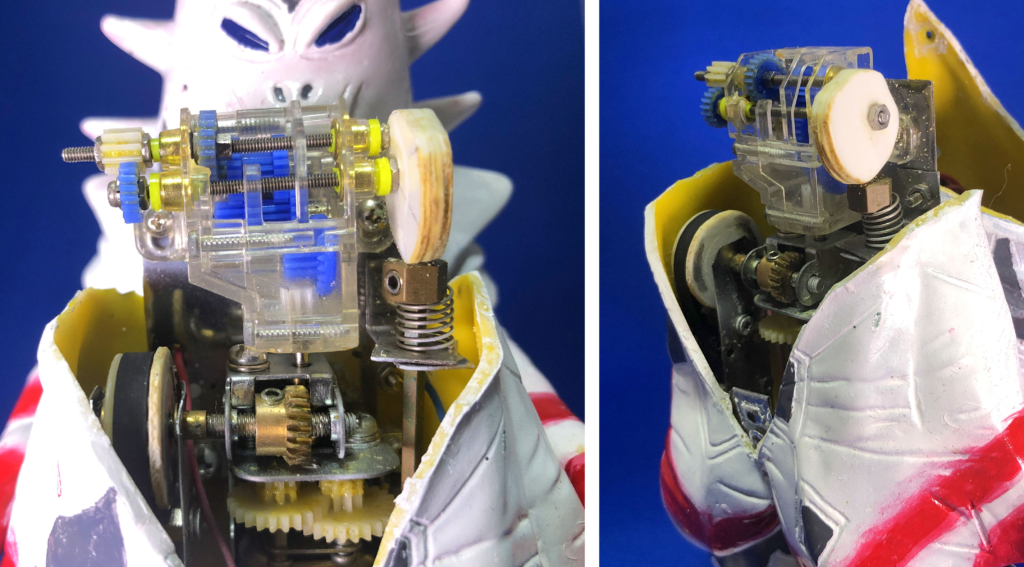
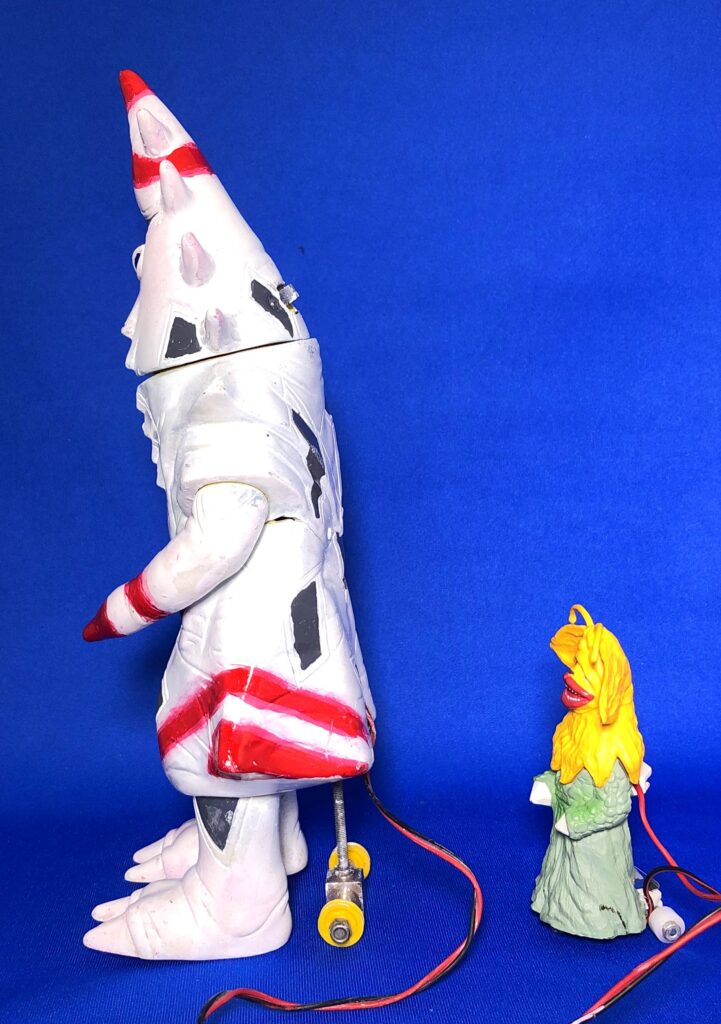
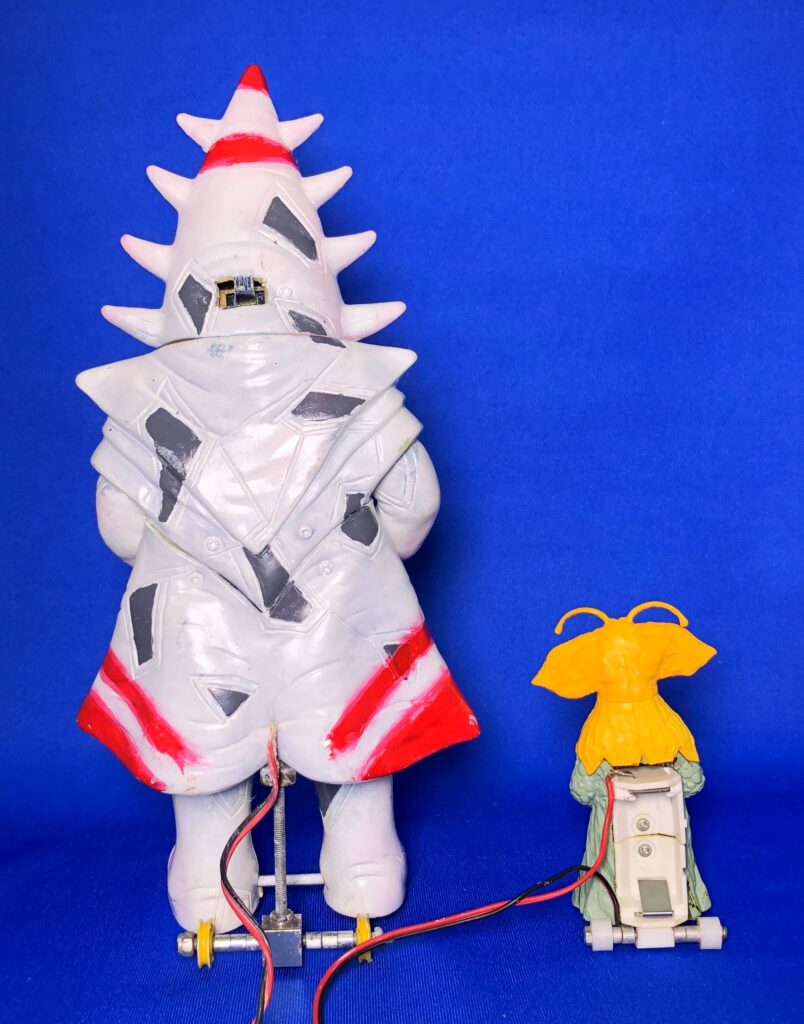
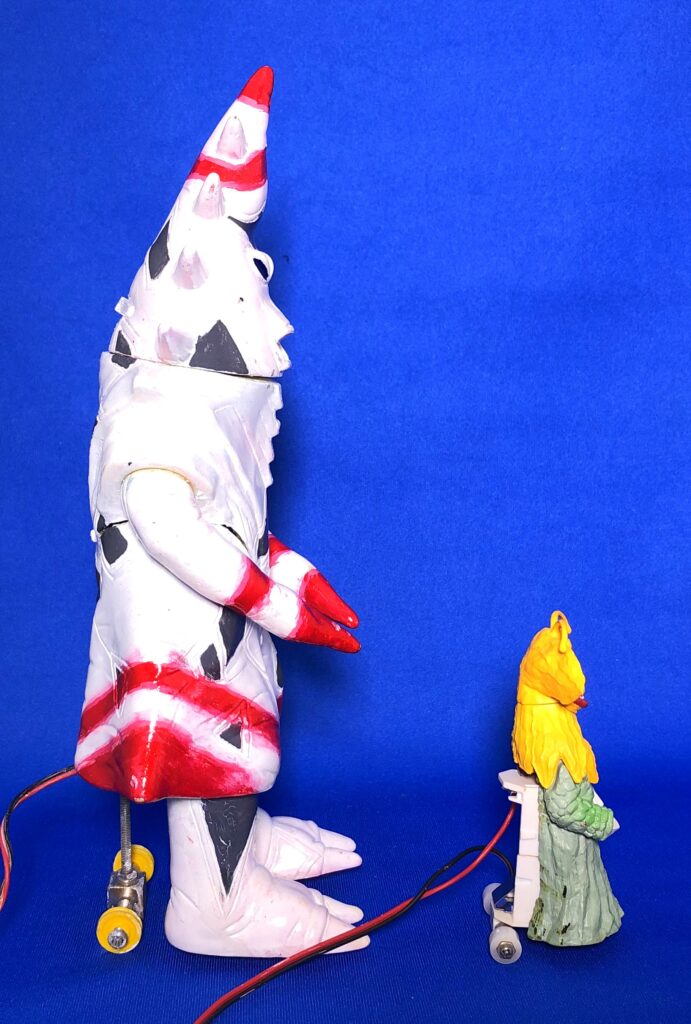
I used a Bullmark soft vinyl doll as the material. It seems that the original soft vinyl dolls are shipped in small numbers and can be sold for a very high price, but for me, the re-released one that I bought for 1,000 yen is good enough. This “Sasahiler" is a soft vinyl model of a human being that has limited space for a drive unit, so as usual, it uses a simple drive belt to run on wheels, but there is a little ingenuity. As shown in the photos, the pinion gear is placed over the 2mm output shaft of the Tamiya “Universal Gearbox" which is installed for walking, and the pin for changing direction is moved up and down by running the “Mini-motor Standard Gearbox" instead of the motor. The reason for this hassle is that I want to make the change of direction as slow as possible. In addition, a switch on the head can be used to recreate some of the lines from the play of “Sasahiler" and “Yametarans." Moreover, for the battery box, I hollowed out the back of the Bandai HG series “Yametarans" and used it. As you can see, my “Sasahiler" is a memorable one that have made various efforts.
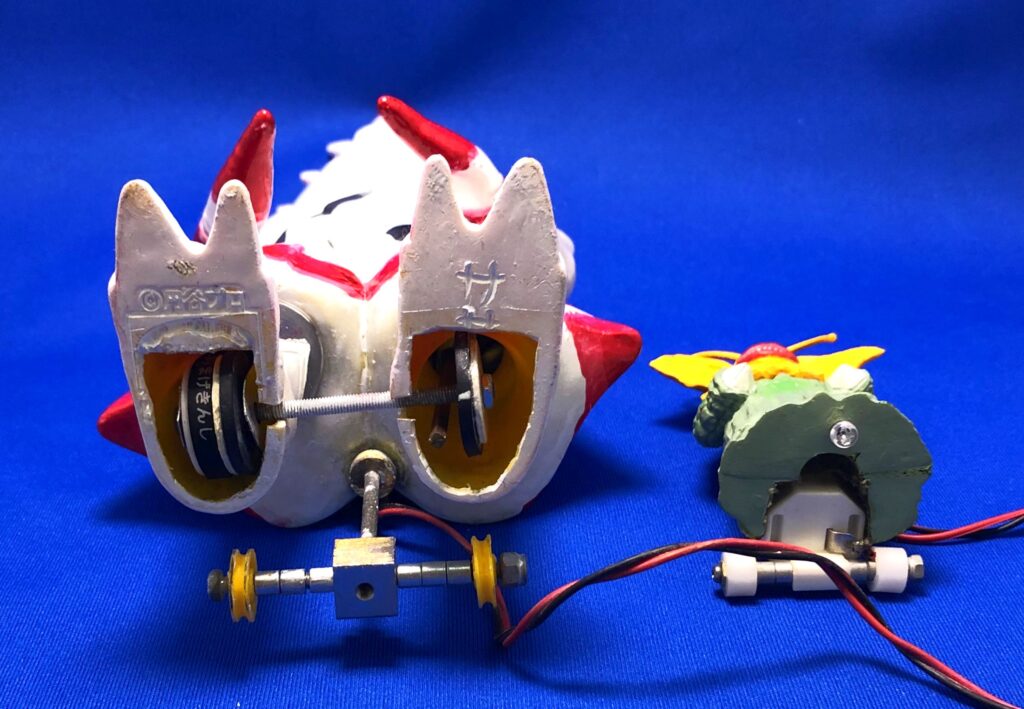
Right: Sole: The wheel on the right foot (left photo) rotates on a drive belt. A pin for changing direction goes in and out of the left foot (right photo).
No.18 Phosphorescent monster “Granadas"
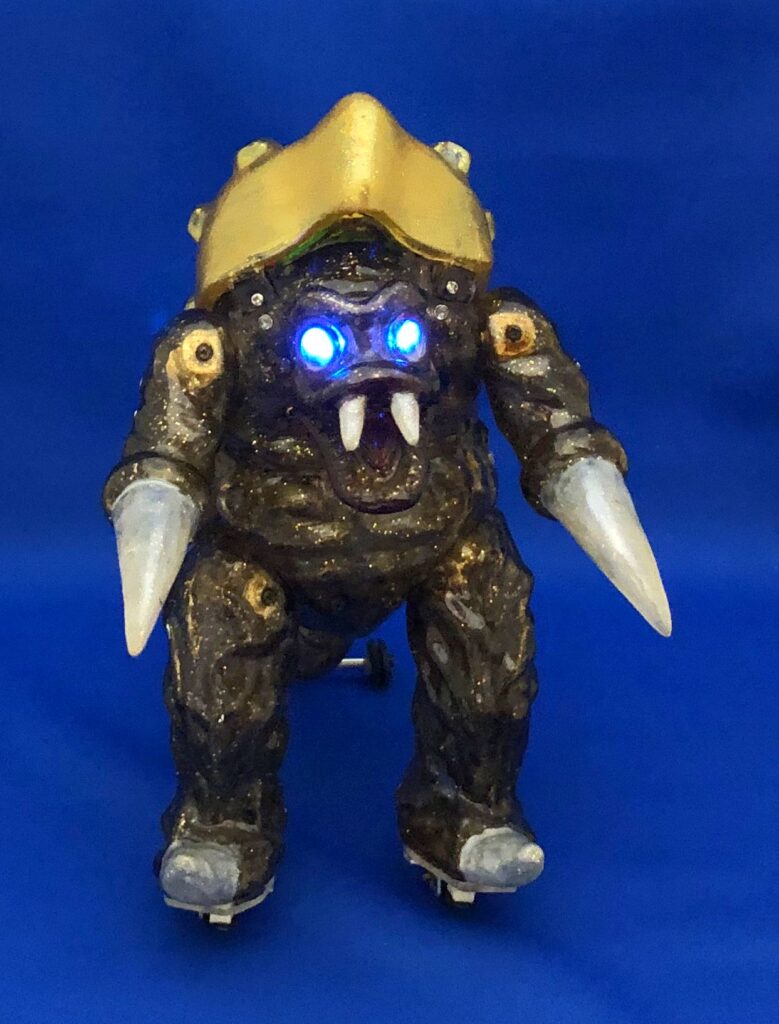
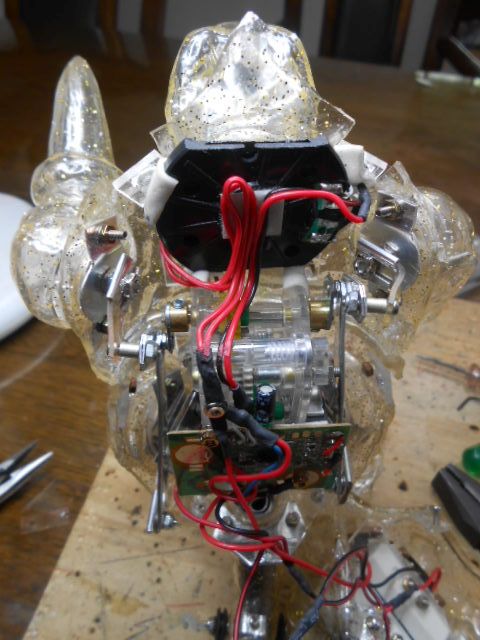
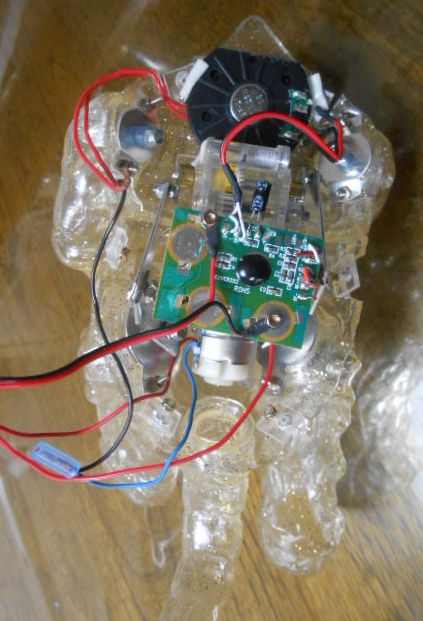
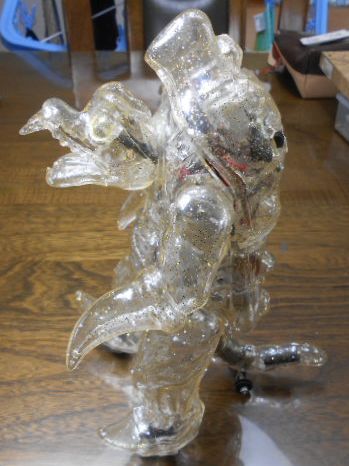
There are only two monsters left. This time, it is the phosphorescent monster Granadas that appears in episode 44, “To the Starry Sky with Love," which depicts the tragic love between Kishida, a member of MAT (Monster Attack Team), and Akane, the Alien Kentauros. Granadas is a strong monster that even Ultraman couldn’t defeat, and is characterized by its eerily glowing eyeballs that look like fireballs said to be the human soul. As the material for the motorization, I used a soft vinyl doll “Granadas clear version" manufactured by Marmit.
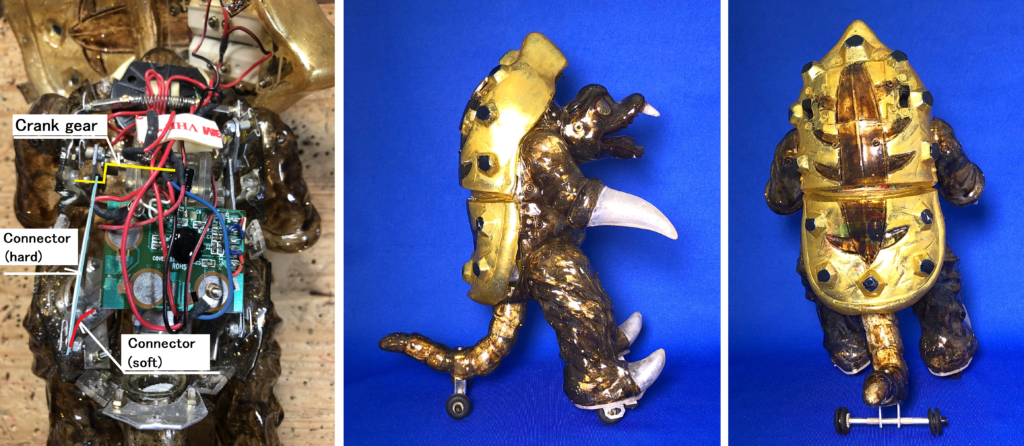
There were three points to the modification. First, I wanted to make the body completely transparent. For this reason, I tried to use as much colorless materials as possible for the internal drive parts, but after completion, I somehow felt inadequate and painted the whole thing with clear paints. Next, I made the eyeballs glow brightly with blue LEDs. A cam is attached to the rotating shaft of the Tamiya “Single Gear Box Clear," which was used as the main engine for this project, and the LEDs flashes mechanically by repeating ON-OFF of the switch for the lights at high speed. Finally, I used soft materials (rubber) for the connectors that connect the crank pins to both limbs, just as I did for the “Terochilus." Usually, the arms and legs of soft vinyl dolls are movable by mating, but their rotation axes are not parallel, and it is difficult to move both arms and legs with a gearbox that has only one rotation axis. For this reason, in the past of this project, I have inserted parts into the gap between the limbs and the body to adjust the rotation axes of both limbs to match, but as you can see in the example of “Arstron," there was a case where the monster had to walk with a scissor gait. This time, however, I used soft materials so that there would be no problem even if the connectors were twisted due to the difference in rotation axes, and I succeeded in making it motorized without destroying the proportions of the soft vinyl doll.
No.19 Plastic monster “Gokinezura"
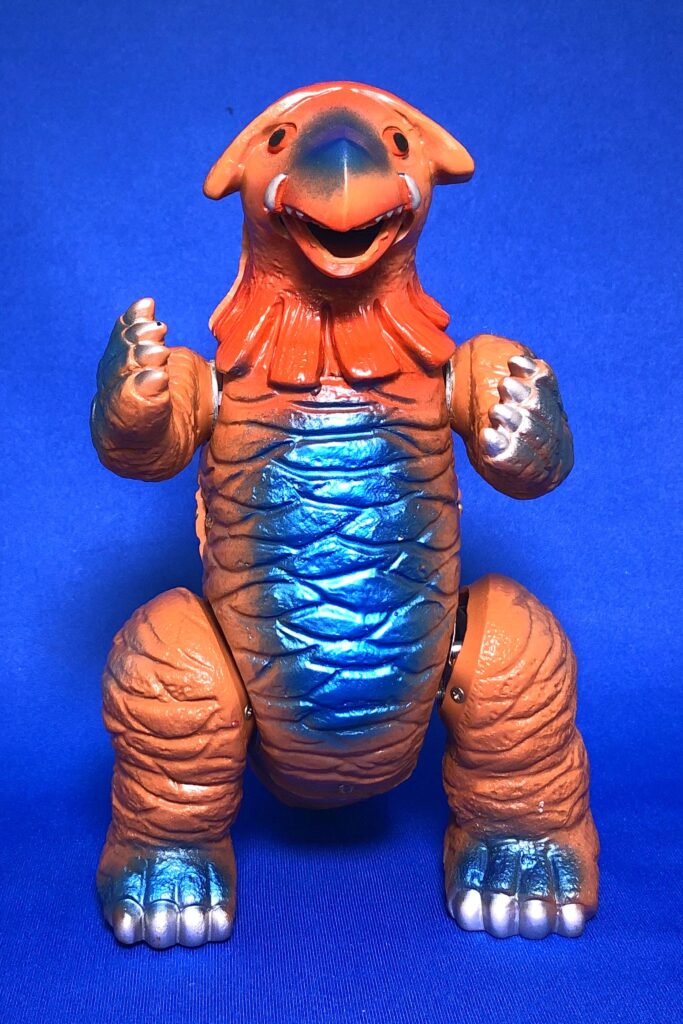
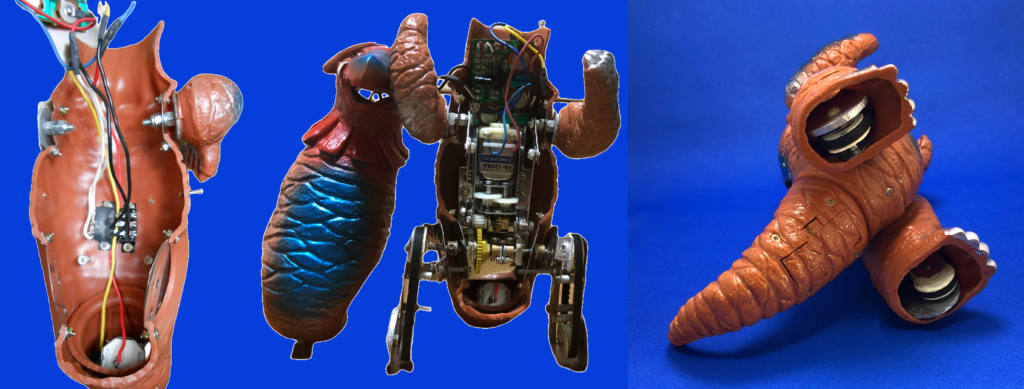
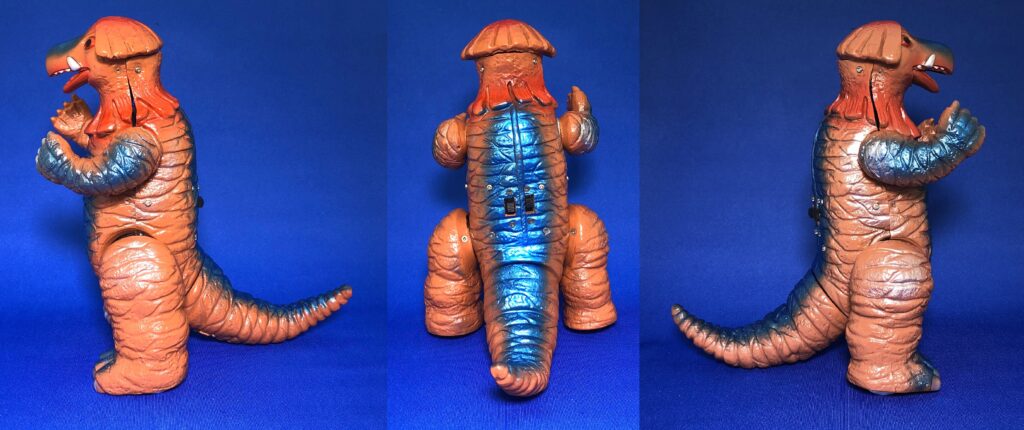
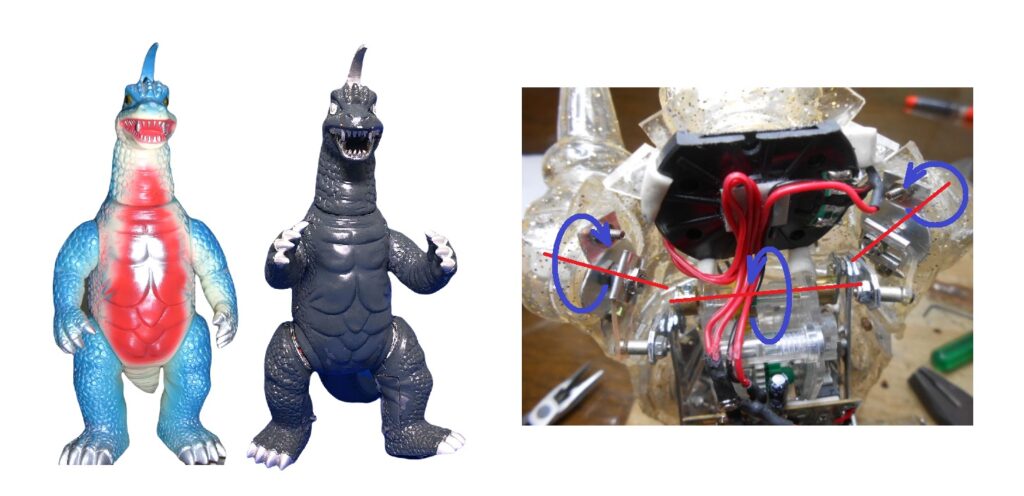
Thank you for your patience with my long series of articles. I would like to introduce the last monster I made, Gokinezura. This monster appears in episode 22, “I’ll Kill This Monster! “, which was shocking at the time because the captain of the defense team “MAT" was replaced midway through the series. This episode, written by Shinichi Ichikawa and directed by Eizō Yamagiwa, was full of highlights, but the hairstyle (?) of this monster was strange and its appearance didn’t seem to fit the content of the drama. However, the soft vinyl doll made by Bullmark has a small but very cute finish, and I decided to use it for this project.
The walking system of “Gokinezura" is used on Tamiya's drive belt and pulleys, which were used in many of the projects, but the tires are mounted eccentrically on the pulleys on the running side so that it can move forward while swinging both legs.
Due to busy work and my family issues, this project has been suspended since this “Gokinezura" which was completed in 2015, but I still have a few soft vinyl dolls that are candidates. In my next article, I would like to introduce such soft vinyl dolls that have not yet been motorized and the concepts of remodeling.